1952 Chrysler Ghia
As the American auto industry returned to civilian production in 1946, overwhelming demand, retooling delays, and material shortages forced manufacturers to rework prewar designs simply to keep showroom floors stocked. While new styling trickled out over the ensuing years, Chrysler Corporation lagged conspicuously behind its rivals, especially General Motors, Ford, and even Studebaker. At Chrysler, styling remained the responsibility of the engineering department, which operated under the peculiar edict that a gentleman should never need to remove his hat when entering a Chrysler product. The result was a series of upright, conservative cars, increasingly out of step with the streamlined, expressive shapes capturing the public’s imagination.
By the early 1950s, chairman K.T. Keller recognized the need for a dramatic course correction and tasked Virgil Exner—recently recruited after his departure from Studebaker—with revitalizing Chrysler’s design philosophy. In a bold bid to attract Chrysler’s attention, Carrozzeria Ghia created the Plymouth XX-500, a stylish four-door fastback built atop the humble Plymouth P20 chassis. The gesture impressed both Keller and Exner, a noted admirer of Italian design, and their enthusiasm paved the way for a creative partnership that injected much-needed excitement into Chrysler’s offerings. With Keller’s backing, Exner launched an ambitious series of experimental “Idea Cars” intended to return style to the forefront of the brand’s identity and help shed its conservative image—restoring Chrysler’s relevance in the eyes of the public and the press alike.
Among Exner’s greatest contributions to automotive design was his belief that a car should possess more than just beauty—it should have presence. He championed the idea that a vehicle’s stance and proportions—how it sat on the road—were as important as its surface details. His cars were muscular not merely through decoration, but through massing, contour, and proportion. Rather than relying on ornamentation, Exner used the car’s very architecture—its silhouette, its haunches, and most notably, its wheels—to create visual drama. He believed the wheels should not be an afterthought but a defining feature of the design, anchoring the car and projecting a sense of motion and power even at rest.
This design philosophy—at once modern, elegant, and assertive—was profoundly influenced by Exner’s admiration for Italian coachbuilding. That admiration would soon lead to a pivotal alliance between Chrysler and Carrozzeria Ghia of Turin. Initially a pragmatic arrangement, the relationship blossomed into one of the most fruitful transatlantic design collaborations of the postwar era. Exner found a kindred spirit in Ghia’s ambitious commercial director, Luigi “Gigi” Segre. Along with his colleague Mario Boano, Segre offered the talents of Ghia’s skilled craftsmen to bring Exner’s ideas to life in metal—efficiently and with exceptional attention to detail.
One of the earliest and most important results of the Chrysler-Ghia partnership was a series of elegant, hand-built show cars and limited-production specials that blended American power with European finesse. Fully engineered and drivable—unlike many of Detroit’s dream cars—these Ghia-built “Idea Cars” embodied Exner’s belief that a car should be more than attractive; it should be sculptural, commanding, and possess a presence on wheels. While the press and public responded with enthusiasm, Chrysler management remained wary of another Airflow-style misstep. Undeterred, export manager C.B. Thomas recognized their appeal to wealthy European buyers and ultimately secured approval for a limited run of Specials that captured the essence of Exner’s bold new design direction.
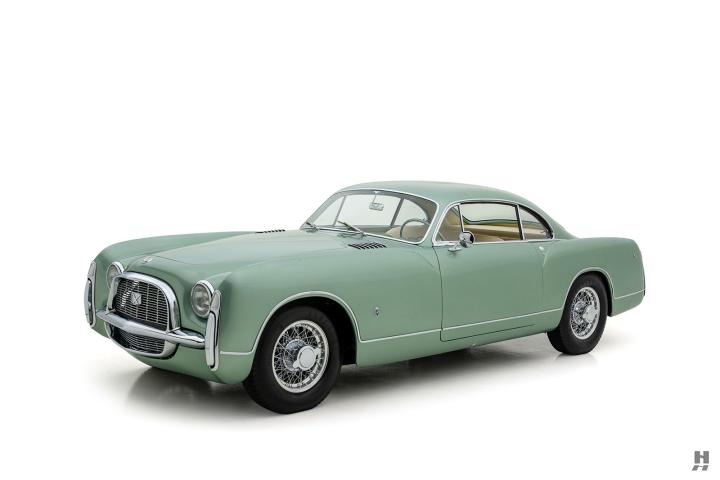
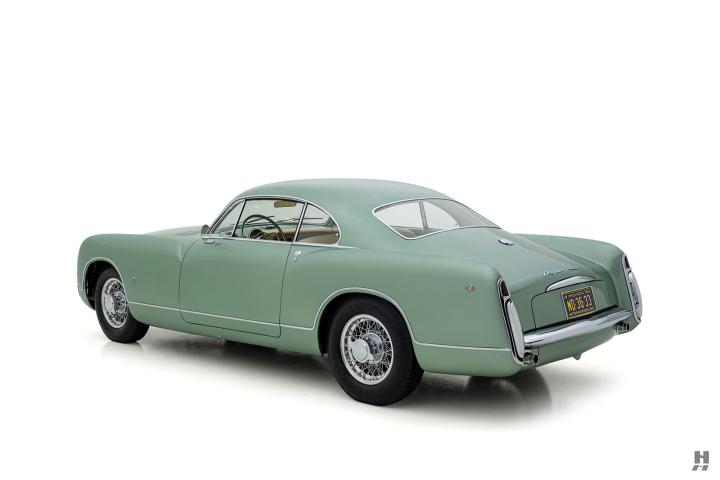
Debuting at the 1952 Paris Salon de l’Automobile, chassis C51834214 was the first—and most significant—the Chrysler Ghia Styling Special. Styled by Virgil Exner and built by Ghia, it signaled a major shift in Chrysler’s design philosophy and for the first time an American had influenced Italian design. Built on a shortened New Yorker chassis with a 119-inch wheelbase and powered by a 331-cubic inch Hemi V8, the car's proportions were dramatic and intentional. With its fastback roofline, knife-edged fenders, and low, sweeping profile, the design conveyed a clear sense of motion and elegance—an automobile seemingly in motion, even at rest. While several Specials were built in various forms, this prototype example remains a true one-off, featuring unique pushbutton door handles, seating for three, and shortened chassis. A striking two-tone color scheme, Borrani wire wheels, and extensive brightwork further enhanced its bespoke character. At Paris, the Americans had captured the attention of the world—with the help of the Italians.
Chrysler retained the Styling Special until it was purchased in 1955 by a client with close connections to the brand. Jim Colee, known for making a car his own, acquired both this car and the Chrysler d’Elegance, adding over one hundred thousand miles to the latter. Under his ownership, he made a few modifications to the car, most notably the installation of a Pontiac 389 and four-speed transmission. While unable to identify the length of Colee’s ownership, it is known he sold the car to John Queen of Long Beach, California.
In 1976, Robert Frumkin of Los Angeles acquired the car from Queen. A recognized authority in the Chrysler marque, Frumkin also owned a Chrysler Ghia Thomas Special during the same period. Fortunately, Frumkin was able to correct the drivetrain by sourcing an era appropriate 331 Hemi motor and 3-speed PowerFlite transmission. The car changed hands again in 1989, when it entered the care of the Blackhawk Collection. There a restoration was commissioned for the Chrysler, finishing the car in a two-tone green color scheme it would wear for the next few decades. The Styling Special was at home among a collection of significant, world-class automobiles. Two more owners followed: first, Richard Scott of Sidney, Ohio, then Michael Schudroff, another esteemed collector with a top-notch selection of automobiles. Mr. Schudroff proudly campaigned the Chrysler on the show circuit, including Pebble Beach in 2010 where it was awarded Most Significant Design.
Following its well-documented history, the Styling Special recently received a comprehensive restoration that returned the car to the aesthetic seen in Exner’s original clay model design, including blackwall tires and a single-tone exterior. During the restoration the Styling Special was fitted with 16-inch Borrani knockoff wire wheels, manufactured to the precise specifications of those it wore at the 1952 Paris Salon—reproduced directly from original blueprints retained by Borrani for this specific chassis. A copy of those original drawings is on file.
Completed in 2025 for debut at the Pebble Beach Concours d’Elegance, the Chrysler won Best in Class for Virgil Exner Early, triumphing over several of Ex’s designs including the formidable Chrysler d’Elegance. Subsequently it went on to win Best in Show at the 2025 San Marino Motor Classic, and Best in Class at the 2026 Amelia Island Concours d’Elegance.
Displaying a rich history that is supported by extensive documentation and fresh from a spectacular restoration, the Styling Special enjoyed a successful run at the show circuit. While Exner had designed cars before this, many say he found his stride with the Styling Special. An opportunity to acquire a car of this pedigree, provenance, and presentation are exceedingly rare; one that is not to be overlooked.
Offers welcome and trades considered.
$ call us!
Stock number 7779
For immediate assistance please contact us